
EcoCore’s hypothesis is that our Carbon Accounts framework would create the strongest carbon pricing signal above any other approach to drive the energy transition throughout the economy.
Businesses recognise the need for a transition to zero emissions, driven by renewable energy adoption and efficiency improvements. However, competitive pressures and profitability constraints limit their ability to act decisively. They need and in fact call out frequently for carbon pricing.[ref]See any high level policy paper on global warming from the World Bank, the International Monetary Fund, the International Energy Agency or the World Economic Forum[/ref]
What Businesses Do Today
Any business wanting to fulfil its Corporate Social and Governance duties will report on the CO2 emissions it causes. The most widely adopted reporting framework[ref]The Greenhouse Gas Protocol from the World Resources Institute and the World Business Council for Sustainable Development[/ref] defines three emissions scopes for businesses:
- Scope 1: Direct emissions from company-owned activities (e.g. burning fossil fuels).
- Scope 2: Indirect emissions from purchased energy.
- Scope 3: Other indirect emissions, such as those from product use or supply chains, often accounting for 80% of a company’s footprint.
Scope 3 emissions are particularly difficult to manage due to the huge number of subcategories, the low data quality, and the high potential for disputes about overlaps. If that wasn’t problematic enough, current practices like annual carbon audits are just too infrequent, delaying the spread of innovation and slowing the energy transition.
Dynamic Carbon Pricing Across Supply Chains
A carbon price applied incrementally throughout supply chains, as would occur in the Carbon Accounts framework, can transform this sluggish process into a dynamic and responsive system. Here’s how it works:
- Cumulative carbon costs: each business adds its carbon costs to products or services at every step in the supply chain. This cumulative pricing incentivises companies to adopt lower carbon alternatives to reduce costs.
- Real-time adjustments: unlike annual audits, this system allows businesses to reflect reductions in carbon emissions in their pricing immediately, accelerating the spread of innovations.
- Decentralised price setting: vendors independently determine carbon prices based on their own emissions and carbon spending, eliminating the need for a centralised emissions catalog and enabling faster decarbonisation.
- The veracity and effectiveness of such independent carbon pricing and the “carbon prudence” of businesses stem from the scarcity and value of carbon tokens in the Carbon Accounts system, which links the carbon tokens to the quantity of fossil fuel supplies that fossil fuel suppliers are allowed to sell into the economy.
Business Benefits of Carbon Accounts
- Enhanced decision-making: real-time carbon accounting integrates emission considerations into every business decision, from R&D to supply chain management. Emissions become a matter of competitive advantage rather than compliance.
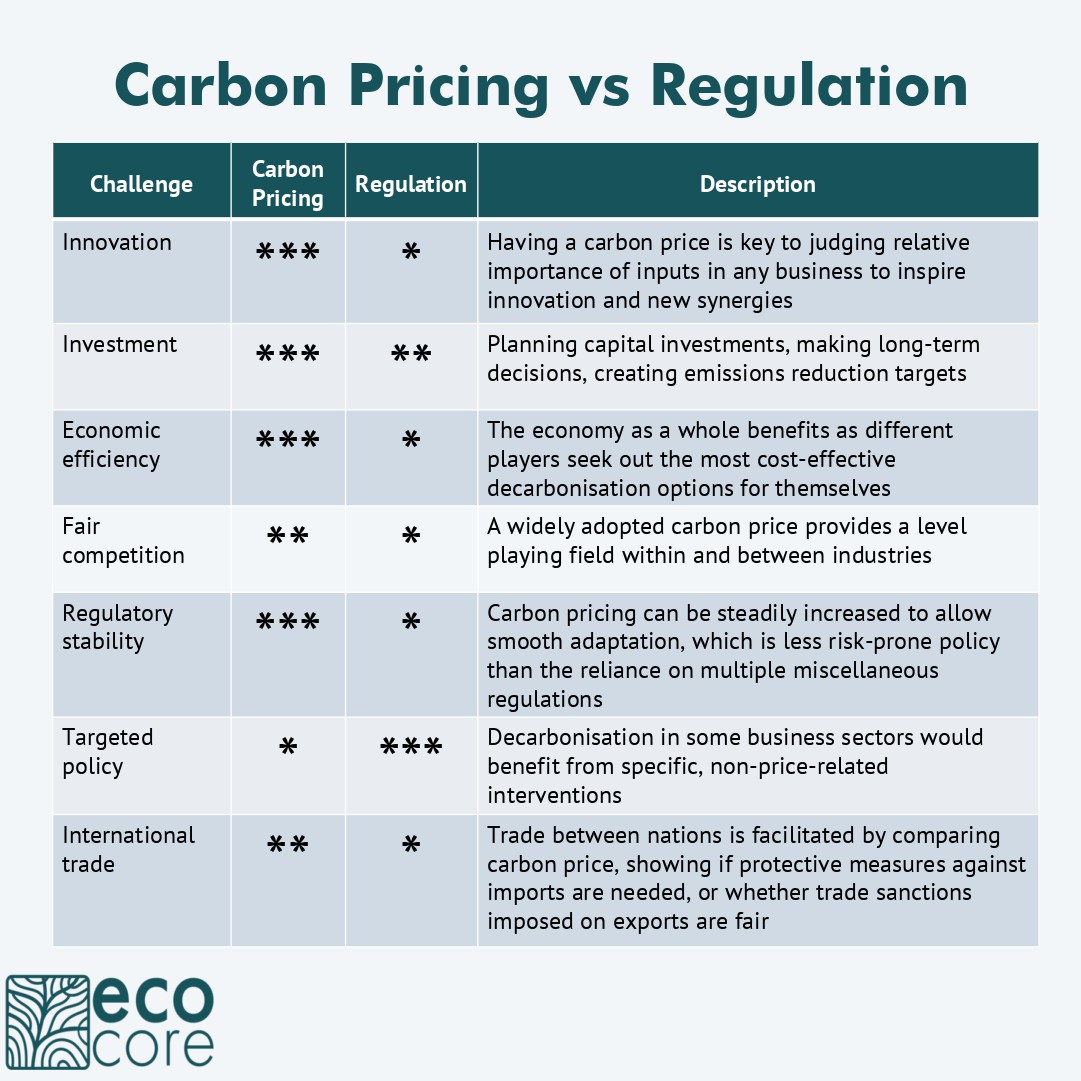
- Innovation catalysis: employees’ growing familiarity with carbon budgets in their domestic settings with carbon allowances fosters innovation and targeted actions within organisations.
- It says it on the tin: the carbon cost of a business’s products will be available on the price label. No more need for corporate marketing campaigns promoting the organisation’s otherwise invisible CSG deeds.
- A double bottom line: businesses operate by necessity with dual metrics—financial and carbon performance—enhancing transparency and accountability.
- Business-to-business impact over heavy-handed regulation: rather than needing to comply with broad-brush state mandates, businesses must look out for their own interests as dictated by the carbon prices of all the products and services in their sector. In the vast majority of cases, EcoCore contends that this will be an accurate representation of the emissions produced. A state watchdog can ensure that damaging or exploitative edge cases are kept in check.
- Hard-to-abate becomes history: the sectors where CO2 emissions are considered hard to abate will no longer be a policy roadblock. Citizens spending their carbon tokens and their money will decide whether those hard-to-abate emissions are worth it. If the government steps in and subsidises those sectors with carbon tokens, the tokens will still come out of the citizens’ carbon allowance, so again, the people will decide – in this case at the ballot box.
- Simple standards facilitate trade: the Carbon Accounts framework facilitates cross-industry and cross-border trade, and simplifies the evaluation of carbon prices on imports from non-aligned trade partners. Payment of the carbon price of imports is demanded by the border agency and paid by the importer.
- Coverage of all greenhouse gas emissions: methane-polluting businesses such as farms can be incorporated under the Carbon Accounts umbrella through the use of licences priced in carbon tokens, aligning them to the carbon market and placing a fair carbon price on their products (e.g. meat).
Example in Practice: Supply Chain Transformation
Consider a large organisation like the UK NHS. Instead of creating broad decarbonisation plans, each department would manage its own carbon budget. This localised approach encourages precise decision-making and fosters innovation at all levels. Employees’ increased carbon literacy from their domestic lives leads to more effective strategies for reducing emissions.
Combating Business Cycle Lags
By embedding carbon costs into everyday transactions, businesses can respond dynamically to market conditions. This reduces delays in adopting low-carbon technologies, drives faster decarbonisation, and means companies can stay at the forefront of competition.
Other Articles in this Series

The voluntary carbon markets are estimated to have a turnover in 2022 in the order of US$ 2 billion. Current estimates are often quickly followed by forecasts that turnover could reach US$ 50 billion…
Continue Reading Carbon Credits, Carbon Tokens, Carbon Offsets
Carbon pricing: what is it? Essentially it is just information about money – the price signal, which you need if you wish to sell at a high price, or buy at a low one.…

The de facto industry standard for reporting CO2 is the GHG Protocol, with its omnipresent Scope 3 emissions. See the table below for definitions. Scopes 1 and 2 emissions are easily measured and targeted,…

A carbon price is the key factor that business, industry and the economy need for a swift and efficient energy transition. But what kind of carbon price do the carbon markets currently create? This…

Despite decades of carbon trading, CO2 emissions continue to rise, and it seems little can improve the carbon markets. The impact of CO2 emissions remains incontrovertibly a market externality in the free market capitalist…